Tuesday, 12 March 2019

Feb. 27 Day 12 Lost City Tour Day 3 A Farewell to Hammocks

Feb.27 Day 12
 Since we made it to the lost city the previous day, we were allowed to sleep in.  Unfortunately, the group that came in late had to get up at 5 am and they were as rude and loud as they were the night before, with their guide remaining the worst of the bunch.  The requests for them to be quiet started out polite but were no more effective when they became "Shut the #$%% up!".  Once they left we had some time to sleep but Meg and I were awake and she went for a walk by the river and came to breakfast in good spirits. 
 After a filling, starchy breakfast we retraced our steps back to Wiwa camp for another night.  This would be our shortest hiking day with a long descent that was harder on your mind and knees but didn't make you sweat as much.  In spite of it being only a 4 hour hike, we all agreed that the last hour was a long one, probably because of the toll the previous two days had taken on us.  The scenery was as beautiful as ever but we were glad to be hiking just in time for lunch.
 After eating we had a 15 minute walk to a waterfall for a swim.  I was expecting just some water going over a rock but it was beautiful and we swam in our sweaty clothes tp rinse them out.  Several members of the group climbed up the falls and sat in the spray but those injury-minded amongst us stayed down in the pool below, admiring the view and letting the cool water soothe our complaining muscles.
 We walked back to camp, showered, changed into our clean clothes and slept or lounged about for a few hours.  Most showers were still fine but one had a sleeping dog in it and another had a bare wire hanging down in the middle of the stall, not something you'd like to have with you in the shower.   Before dinner, Raphael had us gather in a firehouse to learn about Wiwa culture.  He and Felix had their tamburus which were given to them at adulthood.  They consisted of a calabash filled with powdered seashell and a stick coming out.  When they had time they would chew coca leaves, take a bit of the powder into their mouths via the stick and think about removing negative thought and replacing them with positive ones.  They then spit out the coca/shell mixture and rubbed it around the rim of the calabash, gradually forming a large ring.  The tamburua were made and given to people by their mamu and they could read how people were thinking by the state of their tamburu.  When the ring got too large, they would keep it in one place to be used to perform certain rituals and get a new, more portable one.
 We also heard that when boys came of age they had to live with  a spinster or widow for several months to learn how to live with a woman.  They would fix the woman's house or tend their crops in return for this service.  Felix was asked how he would react if his children wanted to join unban society and he said that he would be happy for them if they chose that life but they had to learn Wiwa ways and respect for nature first.  Both of our Wiwa guides were very open to whatever questions we had and served us coca tea and popcorn while they spoke.
 There were many groups there that night and so we couldn't even fit our bunch at one table.  It was the weakest meal of the trip - canned tuna sauce on pasta.  Everyone was clos to collapsing by the end of dinner and we returned to our bunks, with Wendy's bedbug bunk empty but almost all of the others full.  I had another good sleep at Wiwa camp.

This hut has a solar panel if you look closely.

Our post-hike waterfall.

Felix and Raphael give a talk in the fire hut.

Thursday, 7 March 2019

Feb. 26 Day 11 Lost City Trek 2 - The lost city- all to ourselves!

Feb. 26 day 11
 We had some rain during the night so only clothing that was under the edge of a roof was dry, the rest was still quite wet.  We put on our soaked hiking gear, packed the other wet things in plastic bags, had breakfast and set off.  The coldness of the clothes barely lasted 10 minutes before we started to heat up from the hike and our sweat would have soaked the stuff in a little more time so no big deal.  This was the only rain we saw in the two weeks we spent in Columbia.  Dry season indeed.
 Wendy woke up covered in bedbug bites.  It was surprising, as my mattress and hers were only separated by a few inches on the same board but I had none.  The bites were undeniable and I didn't envy her them.
 Today was listed as being the toughest day of the hike because of a particularly steep ascent and they weren't kidding.  We followed the stream for a bit, having to scramble over rocks.  The next section was on land but very narrow.  Fortunately, there were newly installed fences between the trail and the dropoff, giving us the additional help of having ropes and wires to hold onto as we hiked.  What had been a dusty trail was now a muddy one and the rocks were slippery as we headed up higher and higher. 
 One of our group ate something bad during our stay in Santa Marta and needed a mule for the first day of the hike.  she decided to stay in Wiwa camp until we returned and was asking everyone if they had an extra book they could leave with her, but no luck.
 I'm mainly describing the hiking, but every once in awhile you'd snap out of your staring-at-your-feet-and-moving-on mode and look around at the incredible jungle we were in, a few days away from the nearest paved road. 
 Most places had electricity via generators and a few places even had wifi.  Some of the mule trains that passed us had big, green canisters of propane for cooking with.  For better or for worse, tourism brings modern conveniences bit by bit.  The competition for charging plugs was still pretty fierce during our time there.
 Our basic pattern was every hour we'd regroup to make sure that everyone was still with us.  The guides took turns being at the front and back of the group.  every two hours we'd get a surprise of watermelon or pineapple and oranges.  Every four hours we'd stop for a meal (uniformly huge and starch-packed, lots of energy for hiking).  There was no pressure to hike faster than you were comfortable doing and people would chat and pant together in changing clumps during the day.
 At one place we saw soldiers camped out, giving each other haircuts and taking it easy.  Their rifles were leaning all over the camp but they didn't make anyone nervous.  We drove through many army raod stops during our two weeks in Columbia but they never hassled us. 
 At around noon, we arrived in our camp for the night.  It was a newer, Wiwa-run one and we were told we would be the only ones using it.  It was different in that it was all hammocks which none of our group had done more than nap in prior to today.  The facilities were good enough and we had another good meal before deciding on our next move.
 We decided that instead of spending the rest of the day lounging and having to get up early the next morning to visit the lost city, we do the 1 1/2 hour hike in the afternoon and have the place to ourselves while we visited it.  We had the time and it would make the next day's hike that much easier.
 The hike took us across more jungle, though two rivers we had to take off our boots to cross and tehn a final half hour climbing the more than 1000 steps that led to the lost city.  These steps were often narrow, always wet and slippery and often so worn they were angled downwards.  Many were loose and the slope they made varied from very to insanely steep.  Every step had to be watched and regular pauses for catching breath were made as we followed the centuries-old path.
 So it felt great when we reached the top.  Apparently the site had never been lost but shared amongst the local indigenous people for sacred meetings at various times of the year.  A few decades ago, local archeological robbers found the site and spend years tearing it apart and extracted unknown numbers of treasures for black market sales.  After that the area was made a park and reconstructed followed by its opening for tourism and ultimately, our arrival there. 
 Most of the area was covered by large, circular stone terraces of varying sizes and placements.  The isolation and surrounding jungle really gave it a presence, on top of the fact of teh hard work we had to do to get there.  We were the only ones there besides some soldiers who were permanently stationed there.
 Raphael started us off by leading a ceremony where we were all given coca leaves We were to take any negativity and put it into the leaves.  Then we were to discard the leaves into a pile and focus on positivity and thus enter the site in a positive frame of mind.
 Our guides showed us some marked stones that marked geographic and culturally significant places.  He described a few things about then but said that only a mamo could properly interpret the carvings on the stones.  A mamo is sort of a holy man.  Rafael told us how the high mamos are kept from seeing the sun for 18 years and are kept from women and specially trained to be holy.  The details sometimes changed in translation but the idea was that they were treated differently from a young age, exposed to experiences to put them in an uncommon state of mind and looked upon to guide their village and be lifelong spiritual learners.
 As we moved from one area to another on the site we invariably had to climb more steep staircases.  We had a canine companion all along the day's journey who was christened different names by different hikers.  These names were combined into Gordon B Flea Doggie and he followed us until the next day, never begging for food but often getting underfoot as we hiked.
 We finally came to our final plateau even though we could see more of the city continue up the hill.  The views were excellent and many photographs were taken before our guides came down with our surprise - chips and nuts on a platter edged with Oreo cookies and guava fudge.  I only had a bit of the sweet things as I was down to 1/4 cup of water and couldn't afford to eat the salty snacks.  i was really looking forward to juicy fresh fruit but they were so proud of their platter I didn't complain.
 We took a different back down the lost city which gave us an idea of how sprawling it was.  we went by some huts and several more series of terraces of different sizes and configurations with smaller stone trails leading down that were part of their water system.
 We all dreaded our return down the 1000+ slippery steps.  We went slowly and cautiously with several people slipping but no real injuries. We were already quite exhausted and the descent took all of our remaining concentration.  The first ones to the bottom took off their boots to recross the river but once the guides showed up they took everyone across a series of stepping stones so the slower people didn't have to get their feet wet.
 We were now pushing sundown and this was not a trail that one would want to navigate in the dark.  Parts were difficult but we made it back to our camp just before 6 pm to find that we would be sharing it with several other groups that night.  Dinner was excellent as always but it was loud and crowded as everyone tried to get into their hammocks.  I found them quite uncomfortable and they were so close together that when anyone moved they set off a series of movements along the row of hammock, just like those rows of silver balls on strings that you put on a desk and pull the one on the end to click the rest of them.
 Just as we were nodding off, a loud group arrived and started yelling over us and banging into hammocks.  Their guide was the worst of them and they were quite obnoxious as they got their hammocks sorted.  Eventually we got back to sleep but this was the worst night for sleeping on the trip after the longest day of hiking we had to do.


Meg celebrates arriving at the lost city with Felix.

Straight out of a Kipling story.

Just a few of the more than 1000 steps that we went up, then down.

Wednesday, 6 March 2019

Feb. 25 Day 10 Lost City Trek Day 1 - How lost is that city?

Feb. 25 Day 10
 We got up pre-dawn and piled into 4 x 4s with our bags on top.  We met our indigenous guide, Raphael and his brother-in-law Felix, who would be accompanying us on our journey.  The first hour was on paved roads but it took us a surprisingly long time to get out of the city.  The second hour was on dirt roads that got increasingly rough as we neared our destination.  We were given a good shake by the roads and glad to get out and stretch our legs.  Our chef, Chavez and his helper met us and supplied breakfast.  Plantains and eggs were basics with a variety of fruit juices (lula was a favourite though tree tomato was pretty good too) and choice between black coffee and hot chocolate. 
 We set out after breakfast along a dusty path that mainly lead upwards.  Every once in awhile someone would yell "moolah!" or "moto!" and we'd have to move off of the path to make room for some mules or motorbikes.  We would go by farms with the same animals you'd expect in Canada with houses with open sides and tin roofs.  For some reason the chickens looked particularly healthy, many of them pretty enough to be placed in shows.
 After about two hours we stopped at a shady stand where a lady was selling fresh-squeezed orange juice.  Her business model was excellent as almost everyone had one and it was truly delicious.  A few hours more of uphill slogging followed, landing us at our lunch stop.  The cooking crew had been there for awhile and prepared stewed chicken for us.  For dessert we had our first Gol bars, sort of a version of an O Henry but really tasty when you've been hiking.  We also saw the setup for most of the sleeping places we would use.  This was an open-sided building filled with rows of bunk beds covered in mosquito netting.  Pretty basic.
 At lunch, Meg noticed one of her two water bottles was leaking and had a chip out of the bottom of it.  She shouted to the group, "my water broke!"  Some people did not know quite how to react to this news.
 We had about 4 more hours to go before getting to our camp for the night.  Our clothes were soaked with sweat and we piled on sunscreen and bug dope onto the skin that was showing.  I went with long pants and long sleeves but many of the group were in shorts and tees for the trip.  Again, it was mainly uphill but Raphael promised us a surprise at our next stop.  That surprise turned out to be sliced watermelon, which was again a welcome treat.  Many other group were hiking the trail with us and you could see a collection of watermelons at the stop, each labelling with the name of its contributing group.  G Adventures distinguished itself by exclusively using Wiwa Travel and indigenous guides, which we supported.
 After another descent we crossed a metal bridge over a river and left all of the motorcycles behind.  Filipe said that we were crossing into the park and indigenous territory but we couldn't find the exact point where this happened.  After another ascent we had nearly an hour of descending to get to our camp.  Downhill doesn't make you as hot but it takes more concentration and tires out different muscles in your legs.
 We finally made it to Wiwa Camp where we would be spending the night.  It was quite large, with tons of bunk bed stacks, a large dining area, an array of showers and several meeting buildings.  We weren't allowed into our bunks in our hiking clothes so we showered off.  The showers also featured a toilet and were controllable pipes that dumped cold water onto you.  If felt great to be cool and clean and we rinsed out our hiking clothes and put on our clean clothes for lounging and sleeping in. 
 We hung up our wet stuff on lines around camp and went to dine on breaded red snapper.  Our group contained a large number of hot sauce enthusiasts and it was not uncommon for several bottles to be drained at a given meal.  After dinner Filipe warned us to checked our boots and shoes and watch the floor carefully if we got up in the middle of the night.  Bugs, scorpions, snakes and spiders were about and didn't appreciate being stepped on.  This was the jungle, after all.
 Afterwards we headed to our bunks and by 8 o'clock almost all of the exhausted hikers had gone to sleep.  Considering how many people were jammed into such a tight space, we slept well.


Intrepid Meg en route.

Our path to the city.

A Wiwa ceremonial village.

Tuesday, 5 March 2019

Feb. 24 Day 9

Feb. 24 Day 9
 Today we had a free day and so woke up at our own pace and had a leisurely breakfast at our hotel.  We headed out to a botanical garden outside of the city centre which featured the house where Bolivar died.  The gardens were huge and full of wildlife, particularly huge iguanas that could be spotted in most grassy areas.  As lurching as these beasts seemed, Meg got to close to one and we saw how quickly it could bolt away and up a tree when necessary.
 The house of Bolivar had rooms with fairly simple furniture and we felt that we'd have appreciated it more with a bit more background history.  Some rooms had portraits of his generals and famous battles but not with enough context to make them mean much to us.  A case full of tube of sand from various significant places in his life seemed a bit much.
 Sharing these ground was an arts centre with a large outdoor theatre and four rooms full of modern art, some of it quite good.  It was a hot day so we strolled through the park looking at plants and iguanas before grabbing a cab back to the city centre.  It cost a bit more to return as the cabbie had to "tip" the guard at the gate who called the taxis for the tourists. 
 Back in town we had lunch a ta very funky vegetarian restaurant full of reclining tourists.  It had a varied menu, tasty food and a living wall fed by a series of tubes and nozzles which sprayed mist into the restaurant every little while. 
 Meg went back for a nap while Wendy and I went to the gold museum.  The bottom floor had extensive displays of how the Tayrona people lived before being eradicated by the Spanish.  Very elaborate pottery and goldwork were there with good English explanations.  Upstairs was a room on Bolivar and explanations of local archeological sites but as I ascended the stairs the guard told me I only had 5 minutes until closing so I just scanned the rooms gaining no real insights.
 It closed at 3 so Wendy and I went for a stroll by the water.  The city had a very nice promenade and beach with tanker and a cargo port to the right of the beach.  We went out on a dock which straddled a large marina and watched tourists and hawkers walk around or enter what was probably an overpriced sunset bar just behind us.  On the way back we saw a stray dog that looked like it was about to die, with its eyes open and lying on its side.  Strays were everywhere in Columbia and many of then were pretty sad looking.
 That evening we gathered with Filipe to greet our new members and go over our hike.  We had 7 newbies out of 16 for the trip, most of them younger than us.  We would only need a daypack, leaving our larger backpacks at the hotel.  Everyone seemed excited and a little intimidated by where we were heading, which felt positive.  We then headed out to a Mexican restaurant with good food but were misled by the drinks menu.  Meg and I both ordered the clamato and beer, but the clamato was a brown, briny worchestershire sauce-based glop which tasted horrible.  we had to get a second beer to get the nasty taste out of our mouths.

 The next day had an early start so we headed straight to bed after dinner.

Meg in front of some modern art.

One of Bolivar's iguanas.

Monday, 4 March 2019

Feb. 23 Day 8

Feb. 23 Day 8
 Another nice breakfast and an overcast morning that didn't amount to much except for slightly cool temperatures.  Today's optional activity was a hike to the pools of paradise, deep in the forest.  We met our guide, Ed, and followed him to the road to catch a local bus to the trailhead.  He was still learning English but was willing to try explaining things to us and as a group we were usually able to piece together what he was trying to say.  The bus was surprisingly nice and not horribly overcrowded, about half of our group found seats and they were nice ones.  We were only on the bus for about 10 minutes before we hopped off and started our walk.
 Most of it was along  well-established dirt road with occasional encounters with mules and
motorbikes.  Ed paid off the local woman collecting fares and showed us some of the fruit and insects growing along the way.  He also spoke about local indigenous people and how they were not allowed to intermarry between groups.

 The walk was mainly level and next to a wide, shallow river.  Towards the end we ascended quickly and then had to go down a steep, narrow, crumbly path to get to the water again.  After hiking over rocks and sand we got to the pool.
 It was worth the hike.  It was long, cool, surrounded by vegetation and was fed by a waterfall at the far end.  As you swam and approached the waterfall the current pushed up against you but once you crossed it and neared the base of the waterfall you could ride the current out to the main pool.  Lovely location for a swim.
 Meg and I held towels for each other to allow changes in and out of clothes and Ed had sandwiches, cookies, oranges and water for us.  On the way back we took a much easier path that had many clusters of leaf-cutter ants crossing our way with their cargo.  After we got back on the main road a guy closed the fence to the easier path and locked it, making us think that it was a pay path opposed to the less desirable free one. 
 The hike back was easier and quicker and Meg got some good practice on her Spanish with Ed.  The bus back was just as nice and we were able to shower the sweat and dust off before lunch.
 We ate, packed and were on the bus for a short ride to Santa Marta.  Here the people not signed up for the Lost City Trek were to leave the group so our goodbye dinner was that night.  The hotel was nice, but no Villa Margarita, and the lobby had a life-size dummy with sort of a colourful elephant's head.  Apparently he is a monkey or trickster character in the upcoming carnivale. 
 We dropped off our laundry, settled into our room and then got an orientation tour with Filipe.  The city has a large beach and waterfront promenade unfortunately shared with an active port so that swimming is not recommended.  Simon Bolivar died here so there are lots of statues of him and the villa where he passed away is an attraction we would visit the next day.  We saw a vendor with a whole roast pig in his glass cart and he was gradually shaving away at it and selling it.  We also saw the local cathedral and went down some very active restaurant and club streets. 
 Later we met to go to dinner and had birthday celebrations for one of our group (although her birthday wasn't until the next day) and said goodbye to the leaving members.  All along the street were entertainers who came along to do one song (young boys with some amazing percussion) or hip hop dance before passing the hat.  There were also beggars, with obvious impairments or carrying children and holding out their hands, as well as people walking around with chips, cigarettes or candy.  Our guide said that most beggars were Venezuelans, having fled their country and found work hard to come by in Columbia.  After a coffee with some departing friends we headed back to the hotel to snooze.

Our swimming destination.

Me with carnival creature.

Santa Marta beach.

Sunday, 3 March 2019

Feb. 22 Day 7

Feb. 22 Day 7
After a good night's sleep I got up at 6 and so went to the beach alone.  It was very overcast so I couldn't see the morning sky but the waves were large and crashing nicely.  The skittering crabs that Meg and Wendy mentioned were nowhere to be seen and I only shared the beach with one other person, a worker at the hotel who was raking the sand in the restaurant area.  when I gave him a "buenos dies" he just grunted and looked at his watch, too early for tourists I guess.
 Back at our beautiful lodge, we had breakfast and then piled into a bus for a short ride to our trailhead.  We had to go through a few army checkpoint because we were only a few hours away from Venezuela and apparently this area had more traffickers than others.
 We had an easy but sweaty walk through the rainforest of Tayronaka Park, seeing large golden orb spiders, some toucans and some howler monkeys along the well-groomed trail.  The trail ended at a stream and we hopped into tubes and rode them down the river to our next stop.  Two guys from the tube company swam along with us and pushed the tubes away from hazards so that we didn't get beached or get our butts bumped by rocks.  Extremely pleasant and cooling after a hot hike.

 We stopped at a centre with a small museum of artifacts of the indigenous civilizations that were here before the Spaniards, with pots, gold work, weapons and such.  Our guide then took us to a hut and told us about how the first nations used coca leaves, some of their practices and religion and where they were located.  We had a new group member who had left her seniors tour and joined ours.  Guide eventually came and took her back and Meg speculated that it was more dementia than motivation that caused her to join us. 
 We had a 20 minute walk to lunch, which was an excellent pumpkin soup followed by red snapper.  As we ate we saw some big iguanas up in a tree munching on leaves and some howler monkeys scurry by.  We had one more stop on the way back at a local stall with indigenous weavings, which Meg was taken with an picked up a small (water-bottle sized) shoulder bag.
 Back at our villa I had a swim and everyone relaxed in their own way in this luxurious place.  Reading in the hammock, sipping beer, having a nice dinner with our group and playing chess in the Villa Margarita.  Sweet.

The beach just after sunrise.

A gold piece at the museum.

Iguanas!

Saturday, 23 February 2019

Feb. 21 Day 6 Taganga to Villa Margarita

Feb. 21 Day 6
 The music stopped at about 7 am and started again at 7:30 so we gave up and had a nice breakfast in the hotel's courtyard.  That morning about half our group went snorkeling a short ride from the town.  We went to the border of the closed park that we would have visited if were not exploring the park in February and swam backwards.  It was no great barrier reef, but there were lots of colourful parrotfish and several lager schools of small, shimmery beasties.

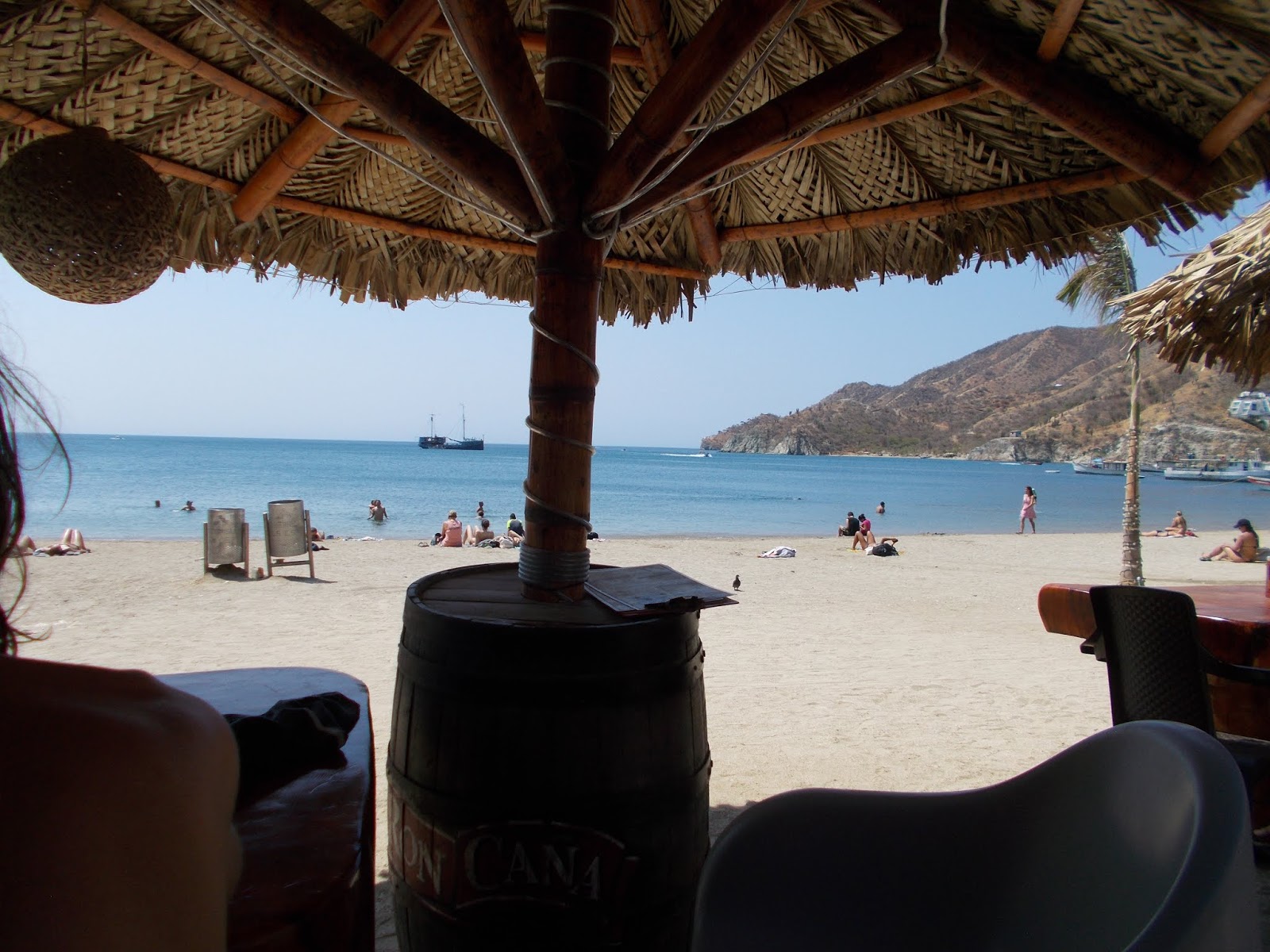
 Back on land we had a nice lunch on the beach where vendors and stray dogs kept coming in to the restaurant.  There are a few cats about but tired-looking dogs seem to be all over the last few towns we visited.  A few of the patrons gave the dog some morsels so it was doing okay. 
 Back at the hotel tired, quiet lounging was the order of the day until we got into a bus and drove for 90 minutes to our next destination.  Along the way we noted that Columbian drivers were not afraid to take chances with oncoming vehicles when passing.
 After many narrow roads we ended up at Casa Margarita, starting with a steep walk up stone stairs but ending with a beautiful lodge with fantastic views.  The stone walkways went through the jungle and the three of us had a cabin on our own with a porch and hammock.  The pool had an edge view of the sea and animal noises could be heard everywhere in the lush vegetation.  Our cabin had an extra bed and had long stone shelves for our luggage, a great location that felt wonderful just to be in. 
 I took a nap and then read in the hammock while Meg and Wendy walked to the beach and reported that it was good with big, breaking waves that made swimming inadvisable.
 Our evening was spent eating good food and conversing with our travel mates.  Many people crawled off to bed early, which was understandable after the last night.  All we had to deal with this night was the jungle noises, which I find help sleep more than hindering it. 


Taganga beach view from our lunch restaurant.

The pool at Villa Margarita.